


The definitive guide to home heating...
Solar, heat pumps, gas, and electric...
Owning a home like the one above may (YOU THINK) cost a lot of money in heating. What if I told you that you could literally heat that home with just ONE 3kW electric fan heater? Admittedly, one fan heater placed centrally might struggle to get the heat to the far flung corners. But if you had a duct system, piping that 3 kilowatts of heat to every room, then it's do-able.
When thinking about home heating (especially if you're reading this on the thoughts of buying a heat pump) you MUST think differently from what you have been told. This is because the best heating system (in all respects) is no heating system at all. Let me explain...
If you had a bucket and you started to fill it with water (just like you switch on your heating system in the mornings), what would you do if your bucket had holes in it?

Would you fill the bucket faster?
Would you fill the bucket in a more efficient way, such as two hoses?
Or would you plug the holes?
Well, you would be crazy not to plug the holes, wouldn't you? Your bucket is losing a lot of water, and to keep it filled, you have to keep adding water. This is exactly the same with your heating - you have to keep adding heat into your home because of what is leaking out. The heat doesn't magically disappear into a parallel universe, it simply leaks out of your house via the walls, floors, ceilings, and gaps. If you stop that, then you can stop adding heat. You would need to add some heat to begin with, but don't have to add any more.
In reality, of course, we cannot seal our homes so that zero heat escapes as that would mean that the air doesn't get changed with fresh air. Your health would soon suffer if that was the case. So you need a ventilation system to bring in fresh air at a constant rate whilst ensuring that your home doesn't simply leak all of its heat. There are two main systems of achieving this; they are called 'Passive' homes and 'EnerPHit' homes.
A Passive home:
This is a home primarily built from the ground up rather than adapting a home which already exists (though it's still do-able). It is a simple system of considerable insulation - thick foam walls, perhaps, and even no metal window and door fittings to lose the heat to outside. You would have considerable insulation in the floors and roof. Your glazing would be triple-glazing, and the gaps between the glass would be filled with a gas.
A EnerPHit home:
This is close to a Passive home, but suits properties that are already constructed, so it is retrofit insulation.
With both Passive and EnerPHit, it is essential that a ventilation system is employed. However, even this uses the heat leaving the property to warm the air coming in - utilising a heat exchanger. This system, called a Heat Recovery System (HRV), is usually located in a loftspace.
So what your heating system adds to your home is held in, rather than leaking out. It doesn't matter what that heating system is, but it should be a simple and inexpensive heating system - NOT a heat pump or solar panels. A heat pump or solar panels are for homes which leak heat. They are trying to replace the leaked heat in an energy-efficient way (though they typically don't!). Forget them, they are for losers! Remember, we are trying to stop that heat from disappearing to outside, so...
INSULATION IS THE KEY
The problem with heat pumps, solar panels, and heating systems in general is that they are ongoing expenses. Every year, they will require you to spend more money on them.* With insulation, it is a one-off expense. Once you have insulated your home, you never have to do it again.
*You may THINK that solar panel systems pay you money rather than cost it. However, that is not the case. Such is their initial capital expenditure, loss of interest on that capital, poor payback times (if ever), and maintenance costs, they are a cost to you. Even with our crazy energy costs here in the UK, typically, a solar panel array simply isn't worth it. I say again...
INSULATION IS THE KEY
Stop the energy leaving and you obviously won't have to replace it. So, now the question is 'What's the best heating system?' My answer will definitely surprise you...it's electric. Electric heating is 100% efficient, simple, and thus reliable. It requires virtually no ongoing costs, no servicing, and is very convenient to operate. I am, of course, assuming that you have spent perhaps £10,000 on insulating your property. Many people prefer to spend £10,000 on a heat pump system, or a solar array system. But remember that we said that there will be ongoing costs with them - it doesn't stop at £10,000. £10,000 spent on insulation sounds a lot - but you could blow all of that on triple glazing! I'm also assuming that you are carrying this out as some part of a restoration or refurbishment project, as retro-fitting insulation is rather difficult. You want to stop that leaking heat through floors which are already laid, walls which are already up, and a ceiling which is already lagged, perhaps. Far better to do it while a house is completely gutted. Welcome to a world of acronyms...PIR, EPS, HRV...!
Britain is, as ever, behind the curve!...
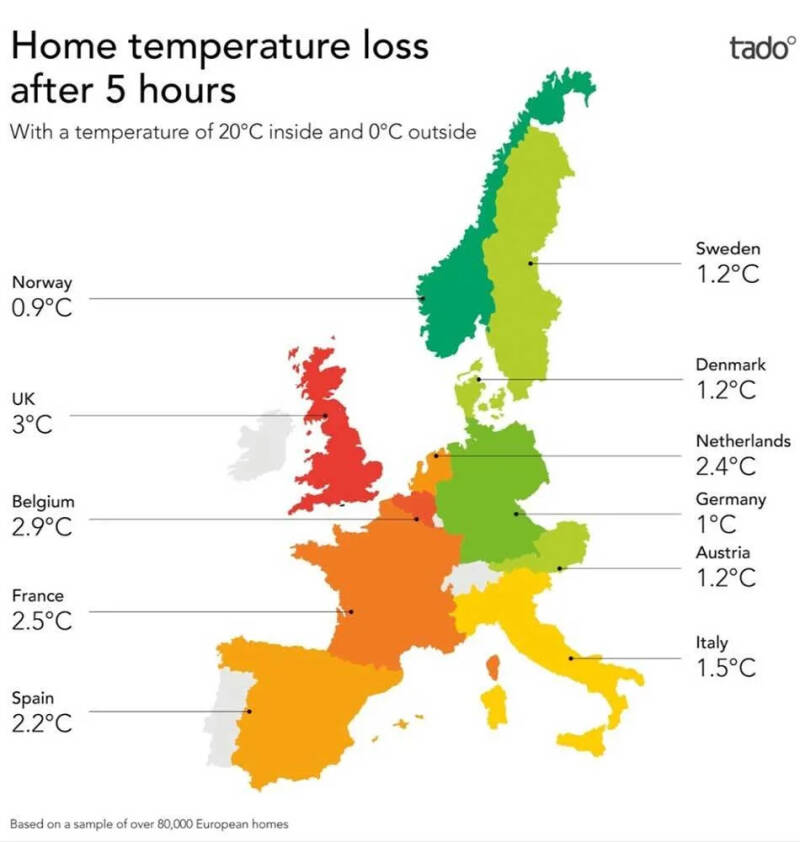
Copyright Tado
So, you're going to want PIR insulation sheets fixed to your interior walls - the thicker, the better. You may also want to insulate the outside walls with EPS. This is within the scope of a diy-er BUT you must ensure you won't cause condensation, so you might want to pay a surveyor for an hour or two for advice. You will almost certainly have to fit new (deeper) window sills, but even this isn't difficult. You should aim for some seriously-thick loft insulation, and (if doing a complete refurbishment) insulate the floors. I have been told that this is easiest when the floors are timber (joists) as these can be ripped up and replaced with PIR sheets and concrete. But get advice from a good builder. If your floor is already concrete, then this could be a major job. Doors and windows should be triple glazed with no thermal bridging - that is to say, not metal handles to conduct the heat to outside. All gaps should be foam sealed. You can employ a business that will put a pressure charge of air into your home to see where it is escaping. Quite obviously, seal up chimneys (allowing for air) unless you intend to burn wood up them. Finally, as we said earlier, a heat recovery ventilation (HRV) system will be essential. It will allow your home to breathe, and eliminate condensation.
What about payback?
Capital invested in a major insulation programme £10000
Amount saved on energy bill £ 1607
So it would look like a 6.2 year payback. But we have to take loss of interest into account…
Interest lost per year £ 300
So £1607 minus £300 is £ 1307
So actual payback is 7.6 years. This is real payback for your £10,000 invested in insulation. This is far and away better than ANY solar panel or heat pump. In seven and a half years, you’ll get your money back, and from then on, it’s just an out and out saving every year on your energy bills.
If you have insulated well, then, as we said, you won't have to heat too much. This frees you up on your choice of heating system. A fancy (and very expensive) heat pump system is certainly not recommended. Over the past few years, many YouTube videos from eager heat pump fans have sprung up. The vast majority of them think that heat pumps typically give you a Coefficient of Performance (CoP) of 4! That is to say that you need only put 1 kilowatt in to get 4 kilowatts of heat out.
No, that's not true.
The average you'll get is a CoP of 2.8. This is because although sometimes the efficiency may well be 4, other times it's 0 - like when the heat pump units defrost themselves - they use electricity for that - that's a dead loss. That 2.8 may still sound good to you - getting 2.8 kilowatts of thermal energy out for every 1 kilowatt you pay for (about 22p in, 62p out), but it actually isn't when you consider the capital costs of such a system and the hoops you have to jump through, such as large radiators, a big hot water tank, all the complex controls, and (most important of all) a local heating engineer who is fully able to work on your system at fairly short notice and won't charge you dentist or vet charges! Heat pumps are not a solution to home heating...and neither is solar!
Solar panel arrays are still so expensive that payback (the period of time they take to pay back your initial costs) can be many years. Oh sure, you'll hear (again on YouTube!) solar panel owners gleefully tell you how their system is going to pay their costs back in five years, or even four!
No, that's not true.
These people aren't very good at mathematics, and the one thing EVERY SINGLE ONE OF THEM forgets is something called 'loss of interest on capital'. If you have £10,000 sitting in an account which you use to pay for solar panels, that £10,000 was earning at least £400 a year in interest. This loss (money you're no longer getting) must be removed from any savings. Only then can you look at getting a true idea on the payback period. But wait, if you don't use that power which is being generated, it can go to waste (or back to the grid)...so you may be talked into getting batteries to store it so it can be used later in the day. Fine, except those batteries aren't cheap, and you WILL have to replace them. That is a certain future cost that you will have to make, so it must be factored into your calculations on payback time, as is a new inverter (the electrickery which converts your DC power to AC). So over the lifetime of your solar system (thought to be 20-25 years) you WILL be spending out, it won't be all take, take, take. Yes, energy inflation (the cost of electricity) will mean that you are partially shielded from what may be a continuation of our crazy energy prices. But don't forget inflation in general - those replacement batteries and inverters will cost more than they did when the system was new. And are you going to stay in your home, or will you move? If you move, those payback figures will all go to the new occupiers of your home - you will have spent out for nothing. And we shouldn't forget the fire risk of solar panels. The risk is small, but still there...
A 4kW solar system with a battery can save you an average of £1,160 per year on electricity bills, depending on your energy usage and the amount of solar electricity you consume. This includes additional savings from storing and using your own generated energy instead of relying on the grid. But how much does it cost to install? That's an average of £11,250.
So you have expended £11,250
You're losing £506 a year in lost interest (your £11,250 was earning you that in interest - which you're no longer getting).
You will also have to pay, in 15 years (or less) for new batteries and a new inverter. That means another (typically) £246 a year.
Maintenance & servicing is, on average, £160 a year.
(These data are from the solar industry themselves, not mine)
That means that you're only actually saving £248 a year. £11,250 divided by £248 is 45 years - TWICE the life of your solar array! There is no payback.
So what's left?
Gas? Gas is cheap and, if your system is designed well, it can be a good heating system. However, it still suffers from breakdowns and maintenance issues - and I've never been a fan of radiators - great big lumps of steel on your wall where dust finds a home.
So we're left with electric. How exactly you use electric to heat your home is your choice. You can use very simple panel heaters. They are cheap and very quick to heat, but they aren't pretty. There's also underfloor heating (UFH), fanned convector heaters, infra-red, blown ducted, and even trench heating (fanned and unfanned naturally-convected). These look great beneath a large window or door and are completely maintenance-free in the case of the unfanned. If I were designing a home from scratch, these are the ones I would go for. In case you're wondering, my home is a combination of UFH and fanned convector heaters (but hidden)...and we love it. For our 3-bed detached home, our heating costs are £1,763 a year. That's probably double what they would be with a gas system, but we don't have any of the disadvantages or hidden costs of a gas system. A heating system is not all about costs - it's primarily reliability, convenience, and control.
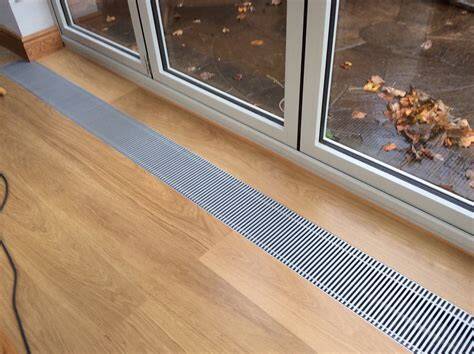
Copyright: Gunning Heating
As I just said, this is my favourite - electric trench heating. They have to be sized properly, but if you go for a passive home, then these are just great - with one trench heater per room. They are completely silent and 100% efficient. A simple air thermostat controls it in each room, so every room is time and temperature controlled independently. In my opinion, as someone with decades of experience, there is no heating system better than this - it's as simple as that. I am about to embark on building my own home (passive house, of course!), and the number one requirement is electric trench heating.
I hope that helps you. As for hot water supply, I suggest a simple immersion heater cylinder (sized for your needs). Our personal use is 4 x showers a day which costs us £1.26 a day (6 kWh - daytime electricity rate).
Data:
Total kWh per year: 8,396 kWh @ 21p/kWh = £1,763
Hot water kWh per year: 2,200 kWh @ 21p/kWh = £462
Disclaimer: Information given is suggested as 'typical' and average. The information and advice provided here are for general informational and educational purposes only. They do not constitute professional, financial, or technical advice. Always consult with a qualified professional or expert in the relevant field before making any major decisions or taking action based on this guidance. The author accepts no liability for any information and/or advice shown, and it is incumbent upon the reader to ascertain advice best suited to their needs.
Create Your Own Website With Webador